A fan taps your profile after hearing one strong track on TikTok. They want the song, your next show, maybe a tee, maybe a way to keep up. If they hit friction, they bounce. That is where the music bio page vs website question gets real for artists. This is not about what looks more professional on paper. It is about what helps attention turn into action.
For most musicians, the honest answer is not that one is good and the other is rubbish. It is that they do different jobs. A bio page is built for speed. A website is built for depth. If you know which moment you are serving, the decision gets much easier.
Music bio page vs website: what is the actual difference?
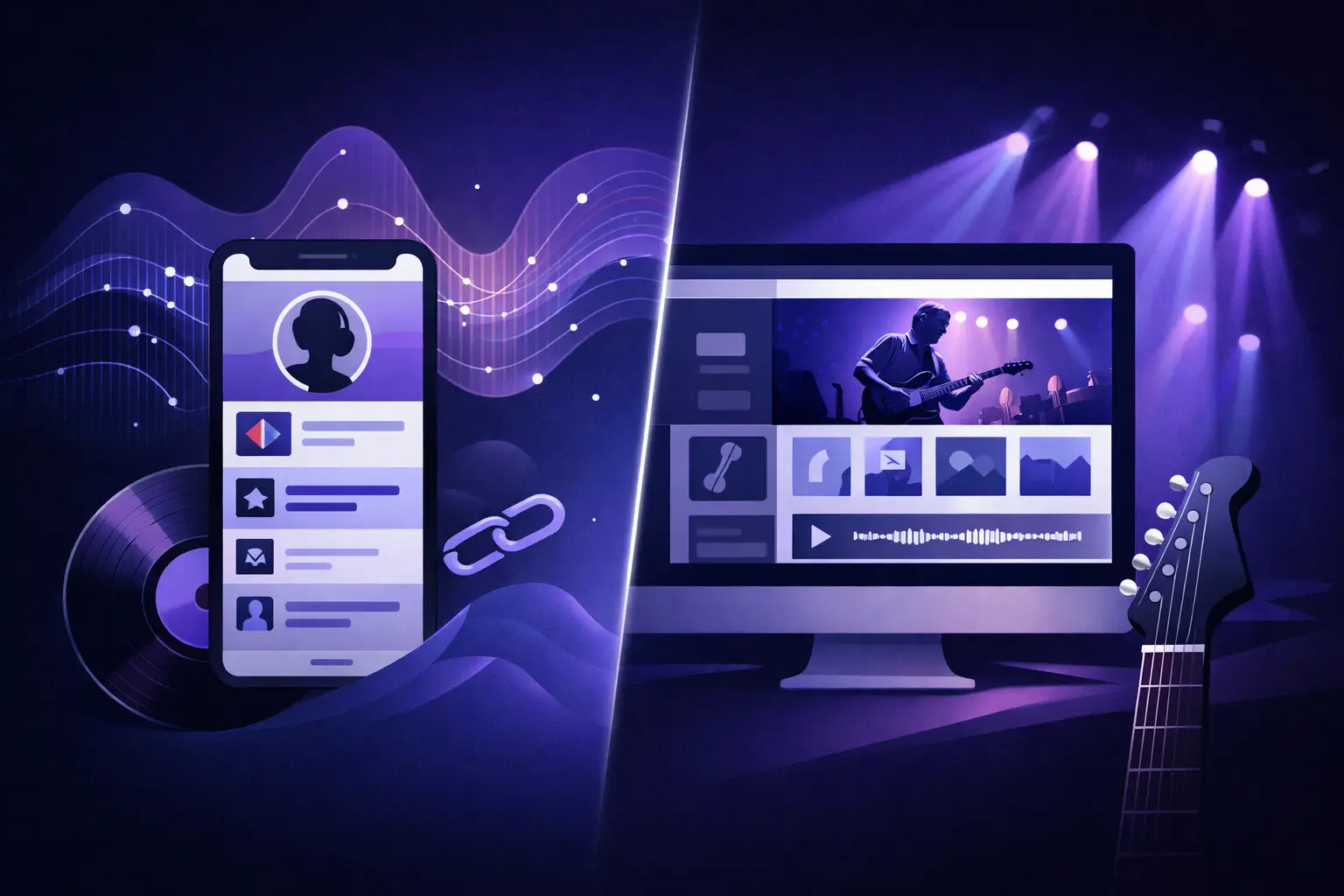
A music bio page is a focused destination. One page, one flow, built for mobile, and designed to catch traffic coming from social platforms. Fans land there and immediately see what matters most right now: your latest release, tour dates, merch, support options, and a way to join your list.
A website is broader. It gives you more room to shape your brand, publish more content, and organise multiple pages around your career. That can include news, media, press information, archives, galleries, and all the extra context that does not fit neatly into a single mobile-first page.
The key difference is not size. It is intent.
A bio page says, here is the next action. A website says, here is the full world.
Both can be valuable. But if your audience mostly finds you through socials, short-form video, streaming profiles, and direct shares, then speed matters more than sprawl.
Where a music bio page wins
If your day-to-day goal is moving fans from discovery to action, a bio page has a real edge. It is built for the exact moment when somebody has just enough interest to tap, but not enough patience to hunt.
That matters because most artist traffic is mobile traffic. People are not sitting at a desktop with ten minutes spare, ready to read your life story. They are on the train, in a queue, between sets, or half distracted. You need a page that respects that.
A good music bio page keeps the path short. One tap to play. One tap to buy tickets. One tap to grab merch. One clear spot to sign up. No dead ends. No clutter. No wondering where to go next.
It also helps you prioritise what is current. If you are promoting a release this week and a run of shows next month, your page can lead with that. When the campaign changes, the page changes with it. That kind of flexibility is useful for independent artists who are constantly shifting focus.
There is another big advantage: ownership of attention. Social platforms are great for reach, but they are not built for your long-term fan relationship. A focused bio page lets you turn borrowed attention into direct connection, especially when you are collecting email sign-ups and guiding fans towards actions you control.
For emerging artists, this can be the smarter first move. You do not need a huge digital setup to look sharp and act like a serious project. You need one page that does the job.
Where a website still matters
A website earns its place when your needs go beyond conversion in the moment. If you are managing a larger catalogue, multiple campaigns, media assets, or different audience types, a website gives you more room to breathe.
For example, managers, bookers, media, and industry contacts may want more than a quick fan-facing snapshot. They might be looking for background, visuals, a detailed story, or a broader picture of your brand. A website can hold that depth better than a single-page setup.
It also gives you more freedom in structure. If you want separate pages for news, about, contact, visuals, or campaign-specific content, a website makes that easier. Some artists also prefer the feeling of having a full digital home base that is entirely their own.
But there is a trade-off. More room often means more maintenance. More pages to build. More content to update. More chances for information to go stale. That is fine if you have the time, the team, or a clear reason for it. It is less fine if your website ends up looking polished but outdated.
An old website can quietly hurt more than it helps. Nothing kills momentum faster than fans landing on a page with last year’s shows, a dead store button, or news that stopped six months ago.
The conversion question most artists should ask first
Before you decide between a music bio page vs website, ask a simpler question: where does most of your traffic come from, and what do you want it to do?
If most of your traffic comes from Instagram, TikTok, YouTube, or messaging, you are usually dealing with warm but fleeting attention. In that case, a mobile-first page built around action is often the stronger choice.
If your traffic includes industry search, press interest, or fans intentionally looking for more depth, a website may play a bigger role.
This is where plenty of artists get stuck. They choose based on what feels official rather than what fits their funnel. A website can feel like the serious option. But serious does not always mean effective.
A fan who wants tickets tonight does not care that your site has six polished sections. They care that they can get where they need to go in seconds.
When a bio page is enough on its own
For many independent musicians, a bio page can carry a lot more weight than people assume. If your main priorities are promoting music, listing shows, selling merch, collecting emails, and giving fans one clean place to land, a dedicated page can absolutely do the heavy lifting.
This is especially true if you are in growth mode. Maybe you are releasing regularly, playing local gigs, building your audience online, and trying to turn casual listeners into real supporters. In that stage, clarity beats complexity.
One strong page can help you look consistent across every channel. It can sharpen your message, cut clutter, and keep your calls to action front and centre. That is not a compromise. That is focus.
When using both makes the most sense
If you already have a website, that does not mean a bio page is redundant. In many cases, the best setup is both, with each playing a clear role.
Your bio page handles fast-moving traffic from socials and campaigns. Your website handles the broader brand presence, deeper information, and anything that needs more space. One captures attention. The other supports the bigger picture.
This only works if the roles are distinct. Problems start when both try to do everything. If your website and your bio page are duplicating the same content with different layouts, you create confusion for yourself and your audience.
The cleaner approach is simple: put the urgent actions where fans can reach them fastest, and keep the slower-burn content in the place built for depth.
So which one should you choose?
If you are choosing one setup right now, choose the one you will actually keep current and the one that matches how fans discover you.
If your career runs on social traffic, release moments, show promotion, and direct fan action, start with a music-first bio page. Make it clear. Make it mobile. Make it yours. A platform like Gigpage is built exactly for that kind of artist journey, where one page needs to do more than just hold links.
If you have broader content needs, stronger search intent, or a team managing multiple types of visitors, a website may be worth the extra effort.
The real mistake is thinking this is only a design choice. It is a strategy choice. What matters is not whether your digital presence looks bigger. What matters is whether it moves people.
Fans do not need more places to get lost. They need one clear next step. Give them that, and your page starts working like part of your career, not just another thing sitting in your bio.
Own the moment first. Then build out from there.